Dès les premiers mois de vie, les mains de l’enfant deviennent de véritables outils d’exploration et d’action. Leur coordination va se développer progressivement, passant d’une simple manipulation à une coopération fine et complémentaire. Comprendre ces étapes aide à proposer des activités adaptées, favorisant le développement psychomoteur de l’enfant.
Au début, l’enfant découvre les objets en les portant à la bouche. Le passage se fait souvent de la main à la bouche, puis de la bouche à l’autre main : l’axe du corps (la bouche) sert alors de “point relais” entre ses deux mains.
Peu à peu, il apprend à passer directement un objet d’une main à l’autre sans le lâcher. Ce stade marque un pas important dans la coordination bilatérale.
Avec le temps, les deux mains commencent à agir ensemble :
- d’abord de manière symétrique (tenir un ballon à deux mains, porter un gobelet à la bouche),
- puis de façon complémentaire (une main soutient pendant que l’autre réalise une action plus précise).
Petit à petit, une spécialisation apparaît :
- la main dominante, qui se dirige vers la précision et la finesse des gestes,
- la main non dominante, qui prend le rôle de soutien et de stabilisation.
De nombreuses activités du quotidien et de jeu favorisent ce développement :
- Jeux de transvasement : cuillères, pelles, entonnoirs, bols…
- Activités de motricité fine : enfiler des perles, visser/dévisser, emboîter, découper, coudre.
- Habillage : boutonner, fermer une fermeture éclair, attacher des lacets.
- Jeux de construction : Kapla, Lego, Plus-Plus…
- Tâches de la vie quotidienne : utiliser une balayette et une pelle, cuisiner (tenir le saladier d’une main et mélanger de l’autre).
Chaque expérience permet à l’enfant d’expérimenter, d’affiner sa coordination et, progressivement, de consolider sa préférence manuelle.
Ces activités ne sont pas seulement ludiques : elles posent les bases de la motricité fine, de l’autonomie dans les gestes du quotidien et des futurs apprentissages scolaires (écriture, utilisation d’outils, activités créatives).
Margaux Gaudin
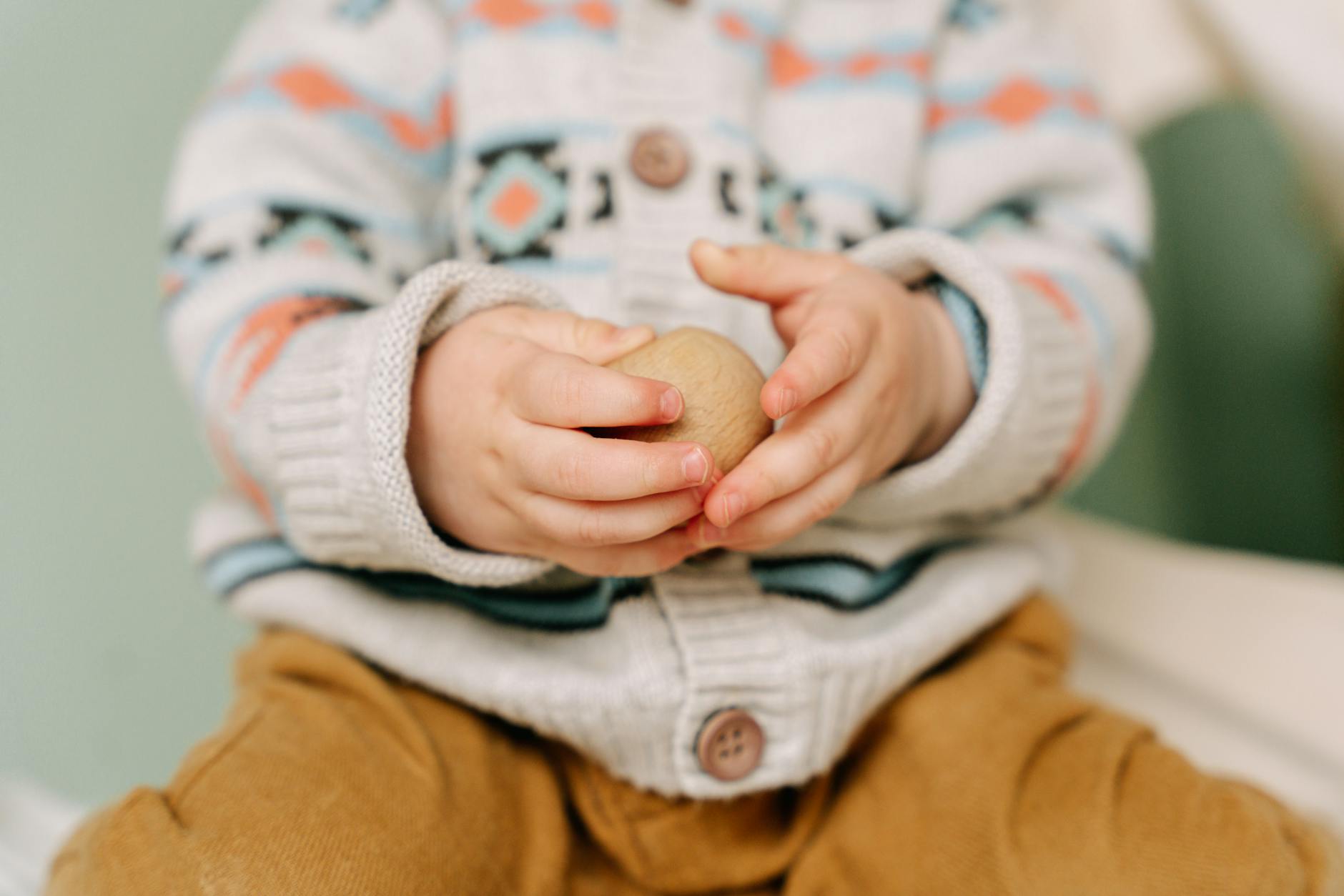
From the very first months of life, a child’s hands become true tools for exploration and action. Their coordination develops gradually, moving from simple manipulation to fine and complementary cooperation. Understanding these stages helps in offering suitable activities that support the child’s psychomotor development.
At first, the child discovers objects by bringing them to their mouth. The movement often goes from hand to mouth, then from mouth to the other hand: the body’s axis (the mouth) thus serves as a “relay point” between the two hands.
Little by little, the child learns to pass an object directly from one hand to the other without dropping it. This stage marks an important step in bilateral coordination.
Over time, both hands begin to work together:
– first in a symmetrical way (holding a ball with both hands, bringing a cup to the mouth),
– then in a complementary way (one hand supports while the other performs a more precise action).
Gradually, specialization appears:
– the dominant hand, which moves toward precision and fine motor skills,
– the non-dominant hand, which takes on the role of support and stabilization.
Many everyday and play activities encourage this development:
– Pouring games: spoons, shovels, funnels, bowls…
– Fine motor activities: threading beads, screwing/unscrewing, fitting pieces together, cutting, sewing.
– Dressing: buttoning, closing a zipper, tying shoelaces.
– Construction games: Kapla, Lego, Plus-Plus…
– Everyday tasks: using a brush and dustpan, cooking (holding the bowl with one hand and stirring with the other).
Each experience allows the child to experiment, refine their coordination, and gradually strengthen their hand preference.
These activities are not only playful: they lay the foundations for fine motor skills, independence in everyday gestures, and future learning (writing, using tools, creative activities).
Margaux Gaudin
LIVE PSYCHOMOT
Articles sur le développement psychomoteur
 LIVE PSYCHOMOT