C’est une grande activité classique pour les bambins qui commencent à être en âge de porter un peu moins les objets qu’ils attrapent à la bouche et une super activité sensorielle : les bacs remplis de féculents !
On retrouve très souvent cette activité dans les crèches ou les MAM mais c’est également une activité facile à réaliser à la maison avec votre enfant (bambin ou plus grand d’ailleurs, les enfants aux alentours de 7-8 mois en raffolent aussi et pour être honnête qui ne rêve pas de plonger sa main dans le sac de haricots juste devant soi au marché? Un peu à la Amélie Poulain…).
Mais pour quelles raisons? Pour le côté enveloppant de l’activité : on plonge sa main, son bras au milieu des féculents, on sent les contours de son corps, aussi possible avec les pieds. Pour le côté sensoriel pur et dur : on touche différentes matières, textures, aspects et parfois températures et on appréhende aussi les aliments que l’on pourrait manger. Pour le côté dedans/dehors : on prend des gobelets et des contenants qui permettent de remplir et vider les féculents dans le bac (limites du corps et aspect visuo-spatial et coordinations oeil/main pour les plus grands). Et enfin pour le côté apaisant et relaxant de l’activité avec un retour à la conscience corporelle et aux sensations tactiles.
Parents, n’hésitez pas à participer et faire avec votre enfant pour comprendre ce qu’il vit mais également verbaliser les sensations et expériences sensori-motrices !
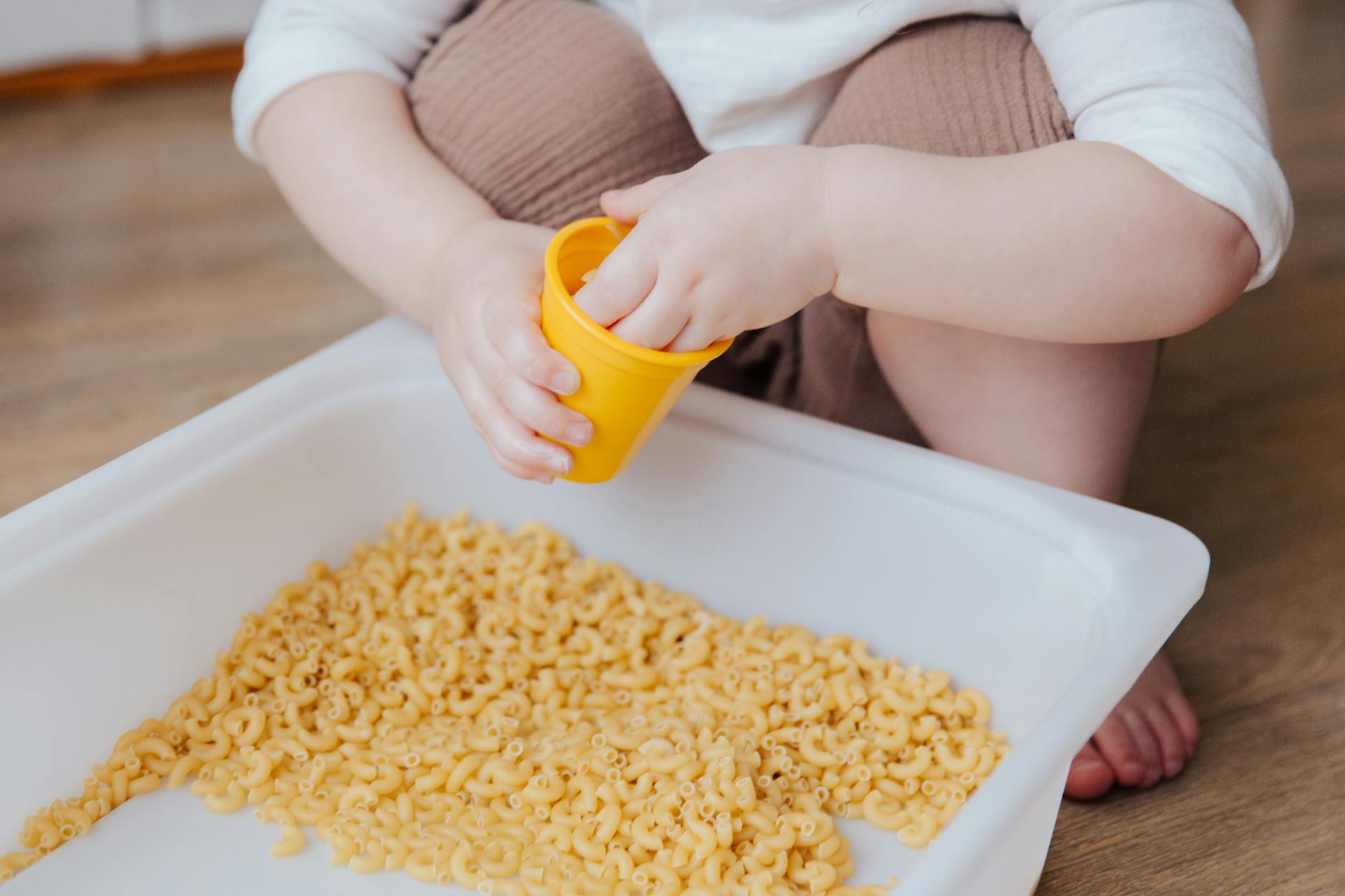
It’s a great and classic activity for toddlers who are starting to be less prone to putting everything they grab into their mouths, and it’s a fantastic sensory activity: bins filled with starches!
This activity is very common in nurseries or childminder settings, but it’s also easy to set up at home with your child (toddler or older ones, around 7-8 months old, love it too, and to be honest, who doesn’t dream of plunging their hand into a bag of beans right there at the market? A bit like in the movie « Amélie Poulain »…).
But why do it? For the immersive aspect of the activity: diving your hand or arm into the midst of the starches, feeling the contours of your body, and it’s also possible with the feet. For the pure sensory experience: touching different materials, textures, appearances, and sometimes temperatures, and also getting to know the foods that could be eaten. For the inside/outside aspect: using cups and containers to fill and empty the starches in the bin (body boundaries and visuospatial aspect, and hand-eye coordination for older children). And finally, for the calming and relaxing aspect of the activity, bringing back awareness to bodily sensations and tactile feelings.
Parents, don’t hesitate to join in and do the activity with your child to understand what they’re experiencing, but also to verbalize the sensory-motor sensations and experiences!
LIVE PSYCHOMOT
Articles sur le développement psychomoteur
 LIVE PSYCHOMOT