L’habillage est une étape clé dans l’apprentissage de l’autonomie chez l’enfant. Apprendre à s’habiller seul renforce son indépendance et nourrit sa confiance en lui. Ce moment fait appel à de nombreuses compétences motrices, comme la motricité fine (par exemple, fermer des boutons ou tirer une fermeture éclair) et la coordination des mouvements (enfiler un pull, un pantalon, des chaussettes). En plus de cela, l’habillage aide l’enfant à mieux connaître son schéma corporel et développe sa proprioception, c’est-à-dire la perception de son corps dans l’espace.
Chaque enfant progresse à son rythme et en fonction de son âge, il est donc normal qu’il ne soit pas capable de tout faire immédiatement. D’où l’importance de diviser les étapes de l’habillage en petites actions simples et adaptées, qui facilitent l’apprentissage. Pour les fermetures éclair, par exemple, un parent peut aider l’enfant à enclencher la fermeture, puis lui laisser la responsabilité de la remonter jusqu’en haut.
Il est essentiel de respecter le rythme de l’enfant en adaptant la difficulté et en encourageant chaque tentative, même maladroite, pour renforcer sa motivation. Quelques aménagements simples peuvent aussi aider, comme un panier où l’enfant peut ranger son pyjama le matin pour le retrouver le soir, ou un miroir à sa hauteur.
Dans le tourbillon du quotidien, il est tentant de faire à leur place pour gagner du temps. Pourtant, en prenant quelques pauses ici et là, on peut donner aux enfants l’espace pour expérimenter par eux-mêmes. C’est en leur laissant ces moments que l’on contribue, pas à pas, à leur autonomie.
Margaux Gaudin
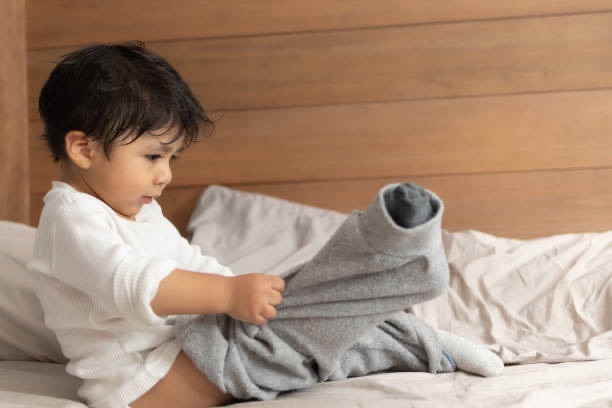
Dressing is a key step in fostering independence in children. Learning to dress themselves strengthens their autonomy and boosts their self-confidence. This moment involves various motor skills, such as fine motor skills (e.g., buttoning or zipping up) and coordination of movements (putting on a sweater, pants, or socks). Additionally, dressing helps the child better understand their body schema and develops their proprioception, which is the awareness of their body in space.
Each child progresses at their own pace, depending on their age, so it’s normal that they can’t do everything right away. This is why it’s important to break down the dressing process into small, simple, and appropriate steps that facilitate learning. For example, with zippers, a parent can help the child start the zipper and then allow them to pull it up to the top on their own.
It’s essential to respect the child’s pace by adjusting the difficulty level and encouraging every attempt, even if it’s clumsy, to reinforce their motivation. Simple adjustments can also help, such as a basket where the child can store their pajamas in the morning to find them in the evening, or a mirror at their height.
In the whirlwind of daily life, it’s tempting to do things for them to save time. However, by taking a few breaks here and there, we can give children the space to experiment on their own. By allowing these moments, we are gradually helping them become more independent.
Margaux Gaudin
LIVE PSYCHOMOT
Articles sur le développement psychomoteur
 LIVE PSYCHOMOT