Jouer au babyfoot, c’est d’abord coordonner ses gestes. L’enfant doit ajuster la position de ses mains, moduler la force de ses mouvements, anticiper la trajectoire de la balle. Il apprend peu à peu à synchroniser ce qu’il voit avec ce qu’il fait. Cela demande de la réactivité mais aussi une capacité à inhiber certains gestes pour en produire d’autres plus adaptés. L’enfant travaille alors sa coordination oculo-manuelle, mais aussi sa régulation tonique.
Le babyfoot sollicite également l’attention. L’enfant doit rester concentré, suivre l’action, s’adapter en permanence. Il apprend à rester engagé, à se réorganiser, à gérer la frustration après un but encaissé. Ce sont des expériences précieuses.
Le corps tout entier participe. Même si les mains sont au premier plan, le reste du corps s’ajuste : les appuis changent, le buste se penche, le regard se déplace rapidement. L’enfant construit des repères dans l’espace, comprend les distances, anticipe les mouvements.
Mais le babyfoot ne se limite pas aux compétences motrices. C’est aussi un jeu social qui implique des règles. On attend son tour, on coopère avec un partenaire, on s’oppose à un adversaire. On partage des émotions : la joie de marquer, la déception de perdre, le plaisir de jouer ensemble. Pour certains enfants, c’est un véritable levier d’inclusion.
Dans ma pratique de psychomotricienne en IME, le babyfoot est actuellement un axe de prise en charge pour un jeune accompagné. Au-delà des compétences motrices qu’il mobilise, ce choix a du sens dans son quotidien. Ne pas savoir jouer au babyfoot le mettait à l’écart des autres jeunes pendant les temps de récréation. Apprendre à jouer devient alors bien plus qu’un apprentissage technique : c’est une porte d’entrée vers les autres. Progressivement, en prenant confiance dans ses gestes, il peut s’engager dans le jeu, partager un moment. Le babyfoot devient un support pour exister dans le groupe, trouver sa place.
Il ne s’agit pas de faire du babyfoot une activité à maîtriser absolument, mais de reconnaître ce qu’il peut offrir comme expériences. Tous les enfants ne s’y intéressent pas de la même manière, et c’est tout à fait normal. À la maison, on peut soutenir cet apprentissage de manière simple. Prendre le temps de jouer ensemble, montrer les gestes, ralentir le jeu au début, encourager les petites réussites. On peut aussi verbaliser ce qui se passe : “tu as vu, la balle arrive vite, tu as réussi à l’arrêter”, “tu t’es adapté, tu as changé de main”. Ces mots aident l’enfant à prendre conscience de ce qu’il fait et à progresser. Derrière le babyfoot, il y a donc bien plus qu’un jeu. Il y a une occasion de grandir, d’expérimenter, de se relier aux autres.
Margaux Gaudin
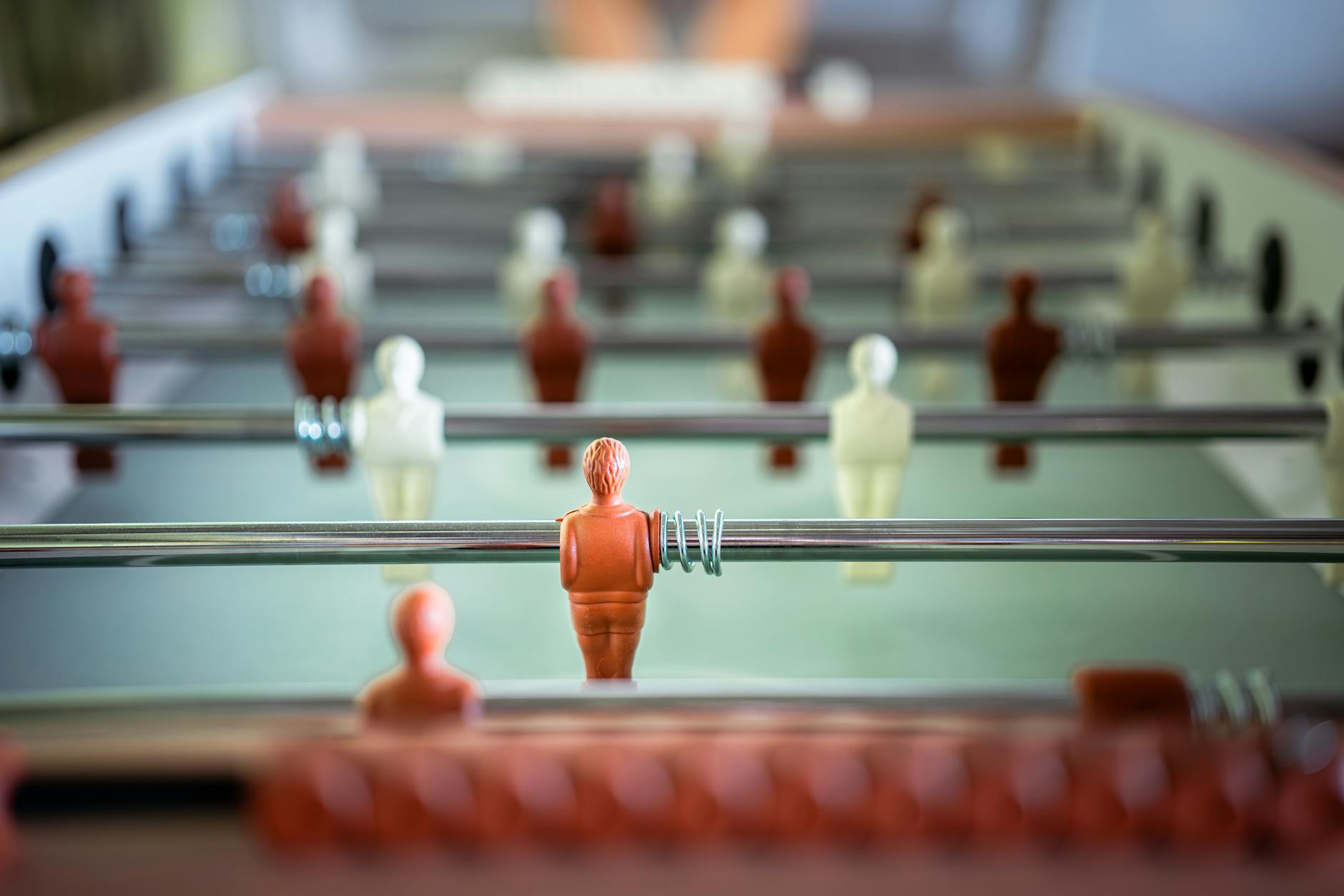
Playing table football is прежде all about coordinating movements. The child must adjust the position of their hands, modulate the force of their movements, and anticipate the trajectory of the ball. Gradually, they learn to synchronize what they see with what they do. This requires responsiveness, but also the ability to inhibit certain movements in order to produce others that are more appropriate. The child is therefore working on their hand-eye coordination, as well as their tonic regulation.
Table football also engages attention. The child must stay focused, follow the action, and constantly adapt. They learn to remain engaged, to reorganize themselves, and to manage frustration after conceding a goal. These are valuable experiences.
The whole body is involved. Even if the hands are at the forefront, the rest of the body adjusts: posture shifts, the torso leans, and the gaze moves quickly. The child builds spatial awareness, understands distances, and anticipates movements.
But table football is not limited to motor skills. It is also a social game that involves rules. You take turns, cooperate with a partner, and compete against an opponent. Emotions are shared: the joy of scoring, the disappointment of losing, the pleasure of playing together. For some children, it is a real lever for inclusion.
In my practice as a psychomotor therapist in a special education setting, table football is currently a focus of intervention for a young person I support. Beyond the motor skills it mobilizes, this choice makes sense in their daily life. Not knowing how to play used to isolate them from other children during break times. Learning to play then becomes much more than a technical skill: it is a gateway to others. Gradually, as they gain confidence in their movements, they can engage in the game and share moments with others. Table football becomes a support for existing within the group and finding their place.
It is not about mastering table football at all costs, but about recognizing what it can offer in terms of experiences. Not all children are interested in it in the same way, and that is perfectly normal. At home, this learning can be supported in simple ways: taking time to play together, demonstrating gestures, slowing the game down at first, and encouraging small successes. It is also helpful to put words to what is happening: “you saw the ball coming fast, and you managed to stop it,” “you adapted, you changed hands.” These words help the child become aware of what they are doing and to improve. Behind table football, there is much more than a game. It is an opportunity to grow, to experiment, and to connect with others.
Margaux Gaudin
LIVE PSYCHOMOT
Articles sur le développement psychomoteur
 LIVE PSYCHOMOT