Au sein du large sujet de la construction du nombre, j’ai nommé la frise numérique. C’est un basique de la logico-maths que j’utilise très souvent en cabinet libéral pour les enfants ayant des troubles des apprentissages car aussi simple qu’elle soit (nous parlons ici des chiffres dans l’ordre de 0 à 9 et donc la base des mathématiques), elle n’est pas si souvent franchement acquise par les enfants d’âge scolaire et peut entraîner alors de nombreuses difficultés à l’école mais aussi au quotidien.
En consultation, je commence d’abord par installer le bon nombre de cerceaux les uns après les autres au sol pour que l’enfant se fasse une idée d’une frise qui “grandit” dans l’espace et en quantité, pour cela on matérialise en comptant à voix haute les chiffres et en sautant dans les cerceaux pour comprendre qu’on augmente le nombre de sauts et donc la grandeur du chiffre. Ensuite, l’enfant pose la bonne quantité de jetons dans chaque cerceaux et perçoit alors la quantité qui augmente en même temps que la frise qui “grandit” et enfin je lui fais poser le bon chiffre en 3D dans chaque cerceau afin d’associer, la frise qui “grandit”, la quantité et le chiffre arabe.
Cet exercice, je le réalise ensuite avec du matériel similaire mais plus petit au bureau pour passer du grand espace avec motricité globale (corps dans l’environnement avec meilleure compréhension pour l’enfant) à un espace plus petit et plus en 2D comme l’espace du bureau pour que l’enfant fasse plus facilement le transfert avec les apprentissages scolaires où généralement il ne “vit” plus l’expérience par le corps mais doit la comprendre cognitivement assis à son bureau d’élève (grâce à des exemples certes, mais sans motricité associée, sans expériences sensori-motrices).
Une multitude d’autres petits exercices de ce type peuvent être adaptés aux enfants ayant des problèmes de logico-maths (ex : situer sur la frise le -1 avec un saut en arrière et le +1 avec un saut en avant ou bien renforcer les notions avant/après et la logique temporo-spatiale sur une frise qui “avance”) et permettent alors de renforcer les bases qui comme nous en avons parlé pour le 4 pattes pour la motricité globale, constituent un socle solide pour les apprentissages plus complexes ensuite.
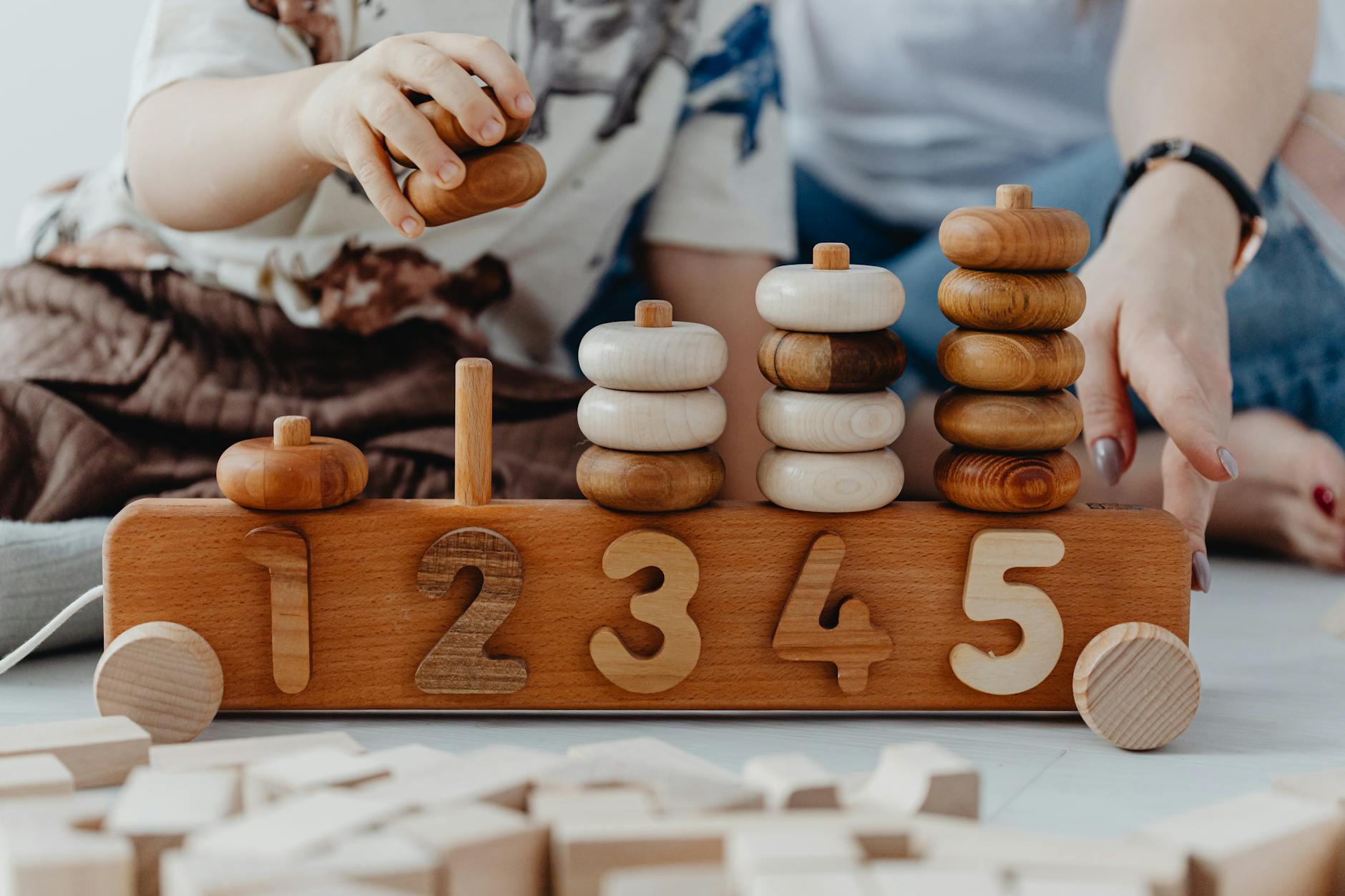
Within the broad topic of number construction, I have named the number line. It’s a fundamental concept in mathematical logic that I often use in my private practice for children with learning difficulties because, as simple as it may seem (we’re talking about numbers in order from 0 to 9, the basics of mathematics), it is not always clearly acquired by school-age children and can thus lead to numerous difficulties at school and in daily life.
During sessions, I start by laying out the correct number of hoops one after the other on the floor so that the child gets an idea of a number line « growing » in space and quantity. To do this, we count out loud the numbers and jump into the hoops to understand that as we increase the number of jumps, the size of the number increases. Next, the child places the correct number of tokens in each hoop, perceiving the quantity increasing along with the expanding number line. Finally, I have them place the correct numeral in 3D in each hoop to associate the expanding number line, the quantity, and the Arabic numeral.
Afterward, I repeat this exercise with similar but smaller materials at the desk to transition from the large space with gross motor skills (body in the environment with better understanding for the child) to a smaller, more 2D space like the desk area. This helps the child transfer the learning to school tasks, where they generally don’t physically experience it but must understand it cognitively while seated at their desk (with examples, of course, but without associated motor experiences).
Numerous other small exercises of this kind can be adapted for children with logical-mathematical problems (e.g., locating -1 on the number line with a backward jump and +1 with a forward jump, or reinforcing notions of before/after and temporal-spatial logic on a « moving » number line). These exercises help strengthen the foundations, which, as we discussed with crawling for gross motor skills, form a solid base for more complex learning afterward.
Marion Bonvarlet
LIVE PSYCHOMOT
Articles sur le développement psychomoteur
 LIVE PSYCHOMOT