Aujourd’hui après une consultation avec un bambin et sa maman autour de la marche “non encore acquise”, j’ai souhaité vous parler d’un sujet peu connu des parents en règle générale : la marche de l’ours. Nous parlons très souvent du quatre pattes, un petit peu du ramper, beaucoup des retournements mais parmi les différents modes de locomotion du tout-petit, la marche de l’ours se fait encore timide.
Il faut savoir que ce bambin en consultation avait été repéré par son médecin pour un “retard d’acquisition de la marche” qui selon les âges de développement est avéré mais si l’on se réfère à l’article “Lenteur”, c’est un rythme différent et temps supplémentaire nécessaire pour ce bébé d’expérimenter avant de se lancer pour faire ses premiers pas.
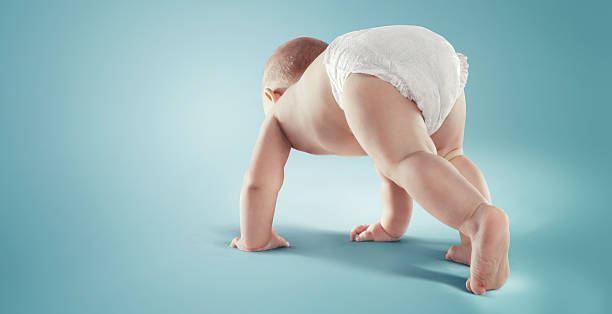
La marche de l’ours donc, même si elle est parfois nommée “quatre pattes”, est différente de ce dernier… Il s’agit tout d’abord d’une étape par laquelle passent certains bébés avant de marcher, une étape intermédiaire donc (mais tout aussi importante que les autres car elle lui permettra une marche plus assurée puisqu’il découvre davantage son corps). Le bébé marche alors non plus sur les genoux et les mains comme en quatre pattes mais sur les mains et les pieds ! Oui, certains se rappelleront cette marche de l’ours dans leur cours de fitness et à quel point elle peut être difficile au niveau de la ceinture abdominale, de son aspect gainage avec le besoin de musculature suffisante pour se porter sur ses jambes et ses bras tant qu’au niveau de la coordination pour avancer tantôt la main tantôt la jambe opposée. C’est tout à fait ce qui en fait un stade intéressant du développement psychomoteur de l’enfant : coordination et tonus ! Ce petit bébé au cabinet était donc en train de préparer davantage la future acquisition de la marche en gagnant davantage en force musculaire, en équilibre et en coordination et donc en ajoutant une corde à son arc (il bouge, cherche, explore sa motricité ce qui est rassurant d’un point de vue psychomot).
Today, after a consultation with a toddler and his mom regarding the « not yet acquired » walking stage, I wanted to talk to you about a topic that is not well-known among parents in general: bear walking. We often talk about crawling on all fours, a little about creeping, and a lot about rolling over, but among the various modes of locomotion of infants, bear walking still remains somewhat obscure.
It’s important to know that this toddler in the consultation had been identified by his doctor as having a « delay in walking acquisition, » which, according to developmental milestones, may be true, but if we refer to the article « Slowness, » it’s a different pace and additional time needed for this baby to experiment before taking his first steps.
So, bear walking, even though it is sometimes called « crawling on all fours, » is different from the latter… It’s initially a stage that some babies go through before walking, an intermediate stage (but just as important as the others because it will allow for a more confident walk as the baby becomes more aware of his body). The baby then walks not on his knees and hands like in crawling, but on hands and feet! Yes, some may recall this bear walk from their fitness classes and how challenging it can be for the abdominal muscles, requiring sufficient strength to support oneself on legs and arms, as well as coordination to move sometimes the hand and sometimes the opposite leg. This is precisely what makes it an interesting stage of the child’s psychomotor development: coordination and tone! This little baby in the office was therefore preparing for the future acquisition of walking by gaining more muscle strength, balance, and coordination, thus adding another skill to his repertoire (he moves, seeks, and explores his motor skills, which is reassuring from a psychomotor perspective).
Marion Bonvarlet
LIVE PSYCHOMOT
Articles sur le développement psychomoteur
 LIVE PSYCHOMOT