Nous revenons aujourd’hui avec les Niveaux d’Évolution Motrices (NEM). Pour petit rappel : ce sont les différentes étapes par lesquels passe l’enfant durant son développement psychomoteur qui lui permettront ensuite d’avoir une motricité harmonieuse au quotidien et d’être à l’aise dans son corps, notamment au niveau des coordination oeil/main (viser/attraper), de son équilibre, de sa fluidité de mouvement et de sa régulation tonique. Nous n’avions pas encore parlé du cabotage : le cabotage, c’est cette étape décrite par les parents comme “un enfant qui marche, mais en se tenant aux meubles”, c’est entre les étapes du quatre pattes, du chevalier servant que nous n’avons pas encore vu, mais que nous verrons prochainement et de la marche.
Le cabotage est très important car c’est le moment où l’enfant va tester son équilibre seul. Il va donc passer du quatre pattes ou de la position assise, au chevalier servant à attraper un meuble, s’appuyer dessus/tirer dessus pour se mettre debout, il va ensuite marcher très souvent en crabe le long de ce meuble. Ce meuble peut être très souvent la table basse, le meuble télé, une chaise.
L’équilibre est bien renforcé car l’enfant comme nous avions vu dans ce lien n’a pas les bras suspendus, il a donc une majorité du poids de son corps avec les mains sous dessous des épaules (et donc il soutient son corps grâce un objet qui est placé en dessous de lui) et il marche en gérant lui-même son rythme. C’est intéressant car, à cette étape, l’enfant qui comprend qu’il peut se saisir d’un meuble pour se soulever, va encore une fois comme dans la posture accroupie/debout, faire des mouvements de flexion/extension et donc renforcer le tonus au niveau de ses membres inférieurs. Il va également avoir un appui au sol qui est similaire à celui de la station debout, et donc comprendre et donner des informations à son cerveau grâce à l’appui de ses plantes de pieds et enfin, expérimenter son centre de gravité dans la posture debout qui est une nouveauté pour lui.
La suite du cabotage, c’est le trotteur. Attention pas le YOOPALA (je vous rappelle dans ce lien pourquoi je déconseille ce dernier) mais bien le trotteur (ce sont ces petits chariots avec une petite barre que l’enfant et suit en roulant) avec davantage de challenge pour l’équilibre et les débuts de la marche.
Marion Bonvarlet
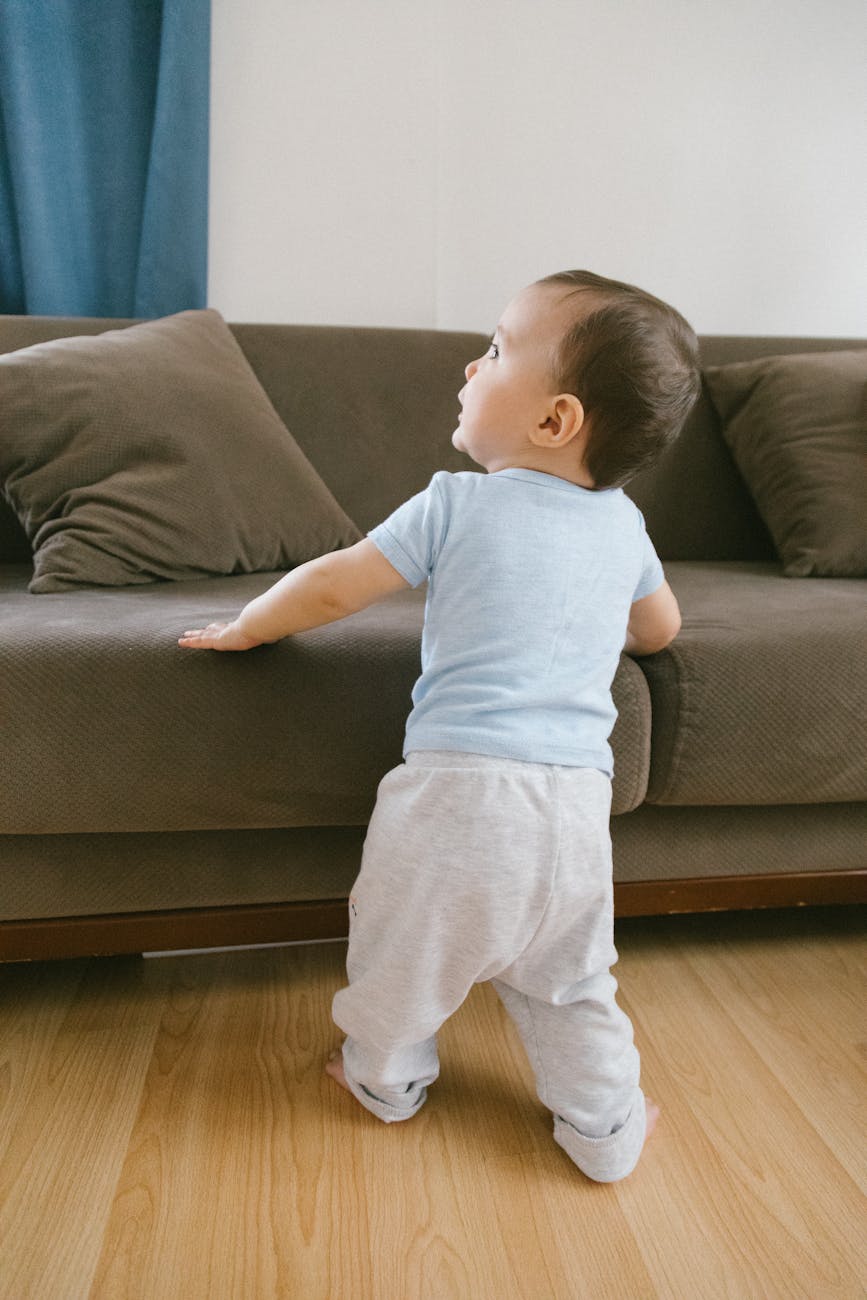
Today we return to the Levels of Motor Evolution (NEM). To recap: these are the different stages a child goes through during their psychomotor development, which will later enable them to have harmonious motor skills in daily life and to be comfortable in their body, particularly in terms of eye/hand coordination (aiming/catching), balance, fluidity of movement, and tonic regulation. We haven’t yet discussed cruising: cruising is the stage described by parents as « a child who walks while holding onto furniture. » It is between the stages of crawling, the knight’s move that we haven’t seen yet but will see soon, and walking.
Cruising is very important because it is the moment when the child will test their balance independently. They will move from crawling or sitting, to the knight’s move, to grabbing a piece of furniture, leaning on it/pulling on it to stand up, and then walking sideways along this piece of furniture. This piece of furniture is often a coffee table, TV stand, or chair.
Balance is greatly reinforced because, as we saw earlier, the child does not have their arms suspended; thus, most of their body weight is supported by their hands under their shoulders (supporting their body using an object below them), and they walk, managing their own pace. This is interesting because, at this stage, the child understands that they can grab a piece of furniture to lift themselves up. As in the squatting/standing posture, they will perform flexion/extension movements, thereby strengthening the tone in their lower limbs. They will also have a ground support similar to the standing position, providing information to their brain through the support of their feet and, finally, experiencing their center of gravity in the standing posture, which is new to them.
The next step after cruising is the walker. Note, not the YOOPALA (I remind you in this link why I advise against it), but the walker (these are the little carts with a bar that the child follows while pushing it), which offers more challenges for balance and the beginnings of walking.
Marion Bonvarlet
LIVE PSYCHOMOT
Articles sur le développement psychomoteur
 LIVE PSYCHOMOT