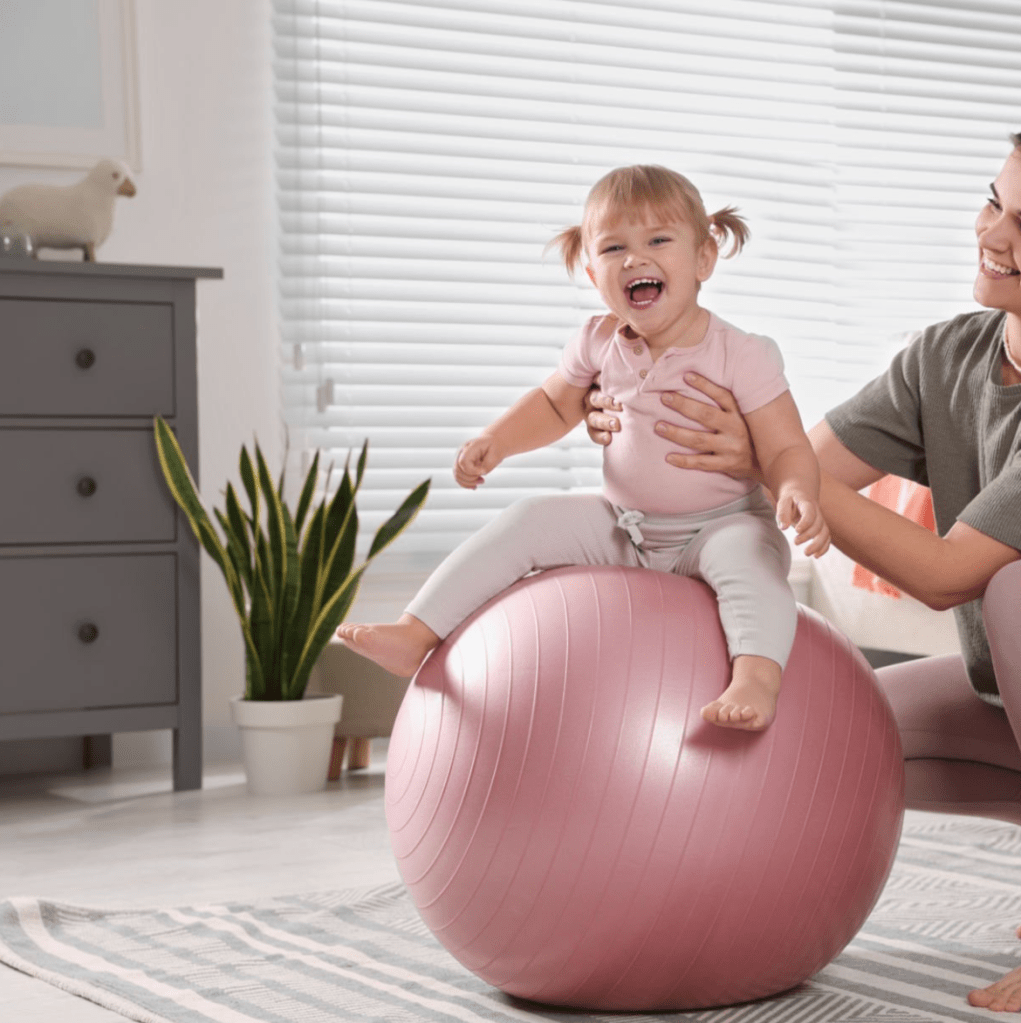
Le rebond ou le fait de rebondir sur quelque chose chez le bébé est une expérience très intéressante. Attention par sécurité, je rappelle que le rebond ne doit pas être dangereux et donc ne doit pas être rapide avec des enfants trop petit et notamment chez les bébés quand la structure crânienne n’est pas refermée (entre 9 mois et 2 ans pour la grande fontanelle devant : on évite donc le syndrome du bébé secoué et on y va en DOUCEUR).
Donc le rebond chez un enfant, quand il n’y a aucun risque et avec douceur, permet à l’enfant :
- de comprendre un rythme avec des rebonds plus ou moins espacés
- permet à l’enfant de ressentir différents appuis que ce soit au niveau du bassin, que ce soit sur les genoux que ce soit sur les pieds ou sur le ventre pour les bébés comme par exemple avec la Swiss Ball.
- permet de comprendre les mécanismes du saut
Je vous conseille donc d’expérimenter le rebond avec votre bébé/enfant dans un cadre sécurisé, avec un tapis et avec une Swiss Ball coincée entre vos jambes par exemple (ou alors avec un gros boudin dans une salle de motricité), d’expérimenter d’abord les rythmes lents, allers-retours devant/derrière et sur les côtés d’abord en douceur, observer les réactions de votre bébé (est-ce qu’il apprécie? ou est-ce que ce n’est pas forcément le cas? est-ce qu’il est trop fatigué? ou est-ce qu’il est en forme pour expérimenter le rebond?).
Ensuite intégrer des petits rebonds en variant le rythme et en faisant des pauses.
Et pourquoi pas enfin d’ajouter un rythme externe avec une petite musique ou en chantant une comptine. Comme d’habitude on verbalise, on met des mots sur ce qu’il se passe pour accompagner son expérience.
Marion Bonvarlet
The Bounce or Bouncing for Babies: A Fascinating Experience
Bouncing or the act of bouncing on something is a very interesting experience for babies. For safety reasons, it is important to remember that bouncing should not be dangerous. It should not be too fast, especially for very young children, particularly for babies whose cranial structure is not yet fully closed (between 9 months and 2 years for the large fontanel at the front: this helps avoid shaken baby syndrome, so proceed GENTLY).
Therefore, bouncing for a child, when there is no risk and done gently, allows the child to:
- Understand a rhythm with bounces that are more or less spaced apart.
- Feel different supports, whether it’s at the pelvis, on the knees, feet, or belly for babies, such as with a Swiss Ball.
- Understand the basics of jumping.
I recommend experimenting with bouncing with your baby/child in a safe environment, using a mat and a Swiss Ball held between your legs, for example (or with a large bolster in a motor skills room). Start with slow rhythms, gentle back-and-forth and side-to-side movements, and observe your baby’s reactions (Does he/she enjoy it? Or not so much? Is he/she too tired? Or in good shape to experiment with bouncing?).
Next, integrate small bounces by varying the rhythm and taking breaks. And why not add an external rhythm with some music or by singing a nursery rhyme. As usual, verbalize and put words to what is happening to accompany your child’s experience.
Marion Bonvarlet
LIVE PSYCHOMOT
Articles sur le développement psychomoteur
 LIVE PSYCHOMOT