S’il y a bien un jeu qui traverse les âges et les générations, c’est bien le puzzle. Derrière ce jeu en apparence simple se cache en réalité un outil précieux, capable de solliciter un large éventail de compétences, tout en s’adaptant aux intérêts et au développement de chacun.
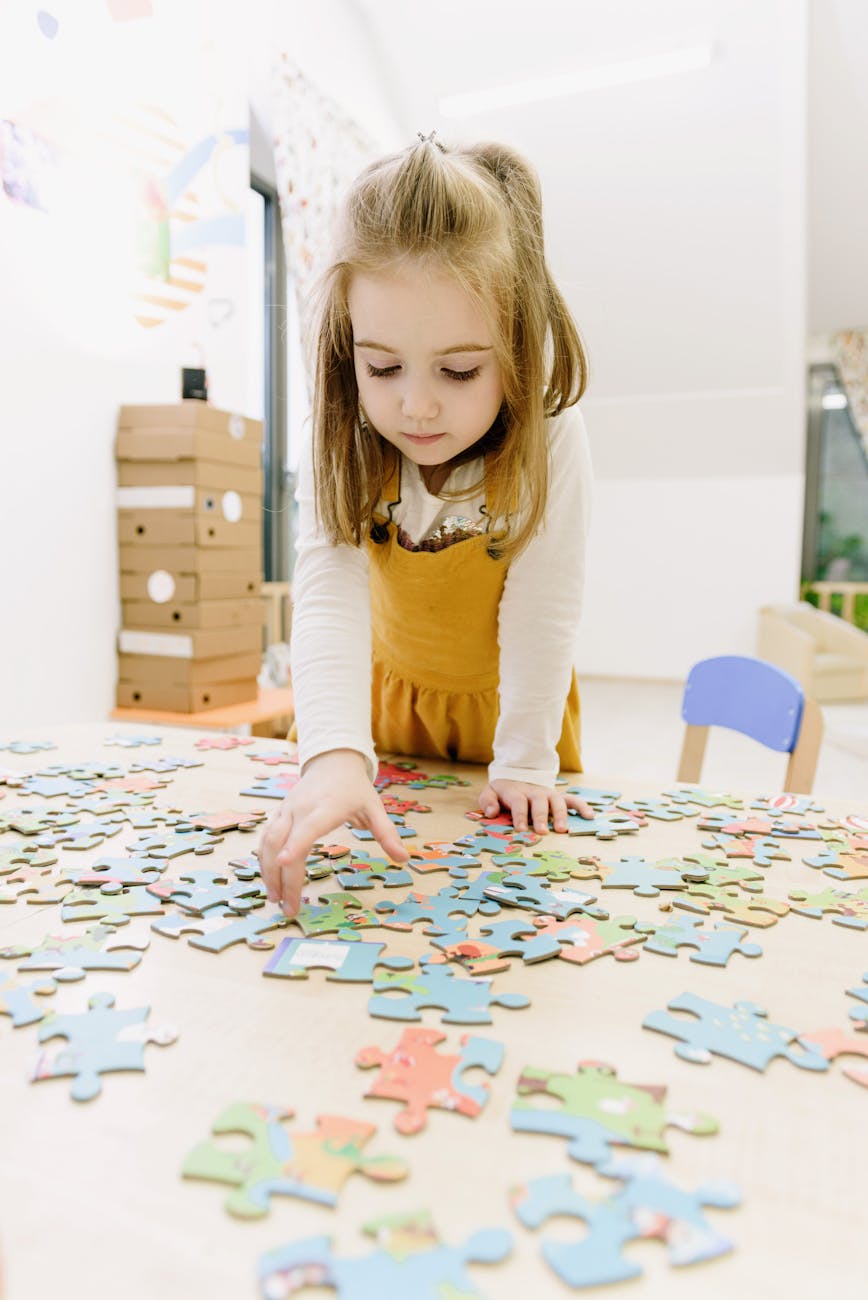
À travers la manipulation des pièces (de tailles et de formes variées), l’enfant affine sa motricité fine, développe la précision de ses gestes et renforce la coordination œil-main. Repérer les contours, associer les pièces, trouver la bonne orientation… c’est un véritable travail spatial qui entre en jeu. Petit à petit, l’enfant met en place des stratégies : commencer par les bords, regrouper les couleurs, anticiper les assemblages. Des étapes précieuses qui l’amènent à planifier, organiser et anticiper.
Mais faire un puzzle, c’est aussi apprendre à persévérer, accepter de ne pas réussir du premier coup, revenir en arrière, chercher une autre façon de faire, voire demander de l’aide quand la tâche devient trop difficile. Et quelle satisfaction lorsque la pièce trouve enfin sa place ! Un moment idéal pour valoriser les efforts fournis, bien plus que le résultat final.
En séance, j’aime proposer des variantes : puzzles pour renforcer la connaissance du schéma corporel ou des repères spatio-temporels, à plat ou en volume, parfois même aux extrémités d’un petit parcours moteur, pour aller chercher les pièces une à une et les assembler en fin de parcours. Car jouer au puzzle, ce n’est pas forcément rester immobile ; c’est avant tout manipuler, observer et se achever la tâche.
Au fil du temps, le puzzle peut gagner en complexité, par le nombre, la taille et la forme des pièces, mais aussi par les couleurs et les détails du dessin. C’est un véritable jeu aux défis progressifs, capable d’évoluer avec l’enfant… et l’adulte, évidemment.
Margaux Gaudin
If there is one game that transcends time and generations, it is the puzzle. Behind this seemingly simple game lies a valuable tool, capable of engaging a wide range of skills while adapting to each person’s interests and development.
Through handling the pieces (of various sizes and shapes), children refine their fine motor skills, develop precise movements, and strengthen hand-eye coordination. Identifying edges, matching pieces, and finding the right orientation—it’s a true spatial exercise. Gradually, children develop strategies: starting with the edges, grouping colors, and anticipating assemblies. These are crucial steps that help them plan, organize, and think ahead.
But doing a puzzle is also about learning perseverance, accepting failure on the first attempt, going back, trying a different approach, and even asking for help when the task becomes too difficult. And what a satisfaction when the piece finally fits! It’s the perfect moment to highlight the effort put in rather than just the final result.
In my sessions, I like to introduce variations: puzzles to reinforce body awareness or spatial-temporal markers, flat or three-dimensional, sometimes even placed at the ends of a small motor course, requiring children to collect pieces one by one and assemble them at the end. Because playing with puzzles doesn’t necessarily mean staying still; it’s all about handling, observing, and completing the task.
Over time, puzzles can become more complex, with an increasing number, size, and shape of pieces, as well as more intricate colors and details in the design. It’s a truly progressive challenge, capable of evolving with both children… and adults, of course.
Margaux Gaudin
LIVE PSYCHOMOT
Articles sur le développement psychomoteur
 LIVE PSYCHOMOT